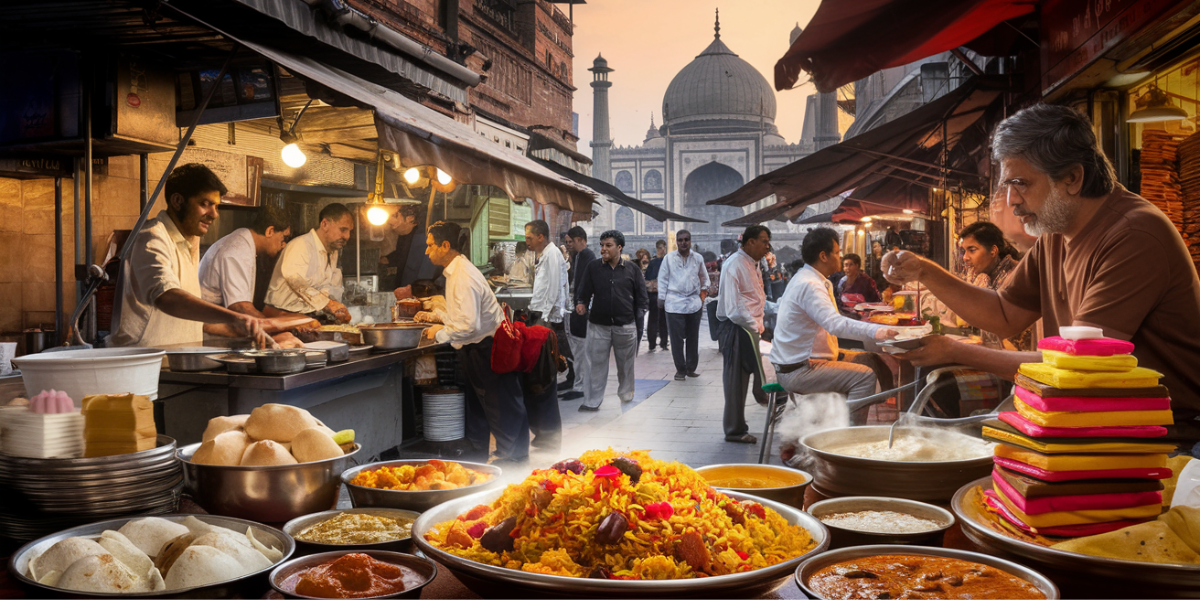
Old Delhi is not only a place on the map; it is a living memory that survives through taste. In the lanes of Old Delhi, still called Purani Dilli by those who belong to it, food is how people remember who they are, where they came from, and what the city once was. The scent of ghee rising from a paratha stall, the slow simmer of nihari near a mosque wall, the sticky sweetness of jalebis pulled from hot syrup, these are not merely dishes. They are fragments of personal and collective history.
Writers, historians, and chefs often say that if you want to understand Old Delhi, you must eat your way through it. In City of Djinns, William Dalrymple observes that Delhi is a city layered with pasts, where different centuries sit beside each other. Nowhere is this layering more visible than in its food. Recipes from Mughal courts, memories carried by Partition refugees, and habits of local halwais all co-exist in the same crowded gullies.
The story begins in Shahjahanabad, built in the 17th century by Shah Jahan. This planned capital had markets, residential quarters, and grand avenues like Chandni Chowk, which soon became a food hub. Mughal emperors brought Persian and Central Asian cooking styles into Indian kitchens. Court chroniclers like Ibn Battuta and Amir Khusrau described royal feasts filled with breads from the tandoor, slow-cooked meats, fragrant rice, dried fruits, nuts, saffron, and rosewater sherbets.
Food historian Pushpesh Pant writes in From the King’s Table to Street Food that Delhi’s cuisine moved from royal kitchens to street corners without losing its richness. The dum style of cooking, the heavy use of spices, yogurt, nuts, and clarified butter, all trickled down into everyday food sold in markets. What was once eaten by emperors slowly became accessible to common people through halwai shops and street vendors.
Walk today through Paranthe Wali Gali in Chandni Chowk and you witness this history flattened into bread. Shops like Kanhaiyalal & Sons Paratha Shop still roll out stuffed parathas fried in desi ghee, served with pickles and chutneys. The parathas are filled with potato, lentils, paneer, or even dried fruits. Locals say their grandfathers ate here, and now their children do too. The lane smells exactly as it did fifty years ago.
A short walk away, the coils of orange jalebi hiss in giant kadhais at Old Famous Jalebi Wala. These jalebis are thicker, chewier, and soaked in syrup that tastes faintly of cardamom. The act of watching them being made is part of the pleasure. Many natives recall being brought here by parents after school, their fingers sticky, their mouths burning from the heat of fresh syrup.
Near Jama Masjid, the food changes character. The air grows heavy with the aroma of meat and charcoal. At legendary eateries like Karim’s and Al Jawahar, nihari bubbles in large pots overnight. Nihari, a slow-cooked mutton stew eaten at dawn, derives its name from the Urdu word nahar (morning). It was once a breakfast for Mughal soldiers before long days of duty. Today, it is eaten with khameeri roti by early risers and night wanderers alike.
These foods are tied to time. Certain dishes belong to mornings, others to winter, others to Ramzan evenings. In winter, a delicate dessert called daulat ki chaat appears briefly on the streets. Food writer Madhur Jaffrey calls it “a frothy evanescence that disappears as soon as it touches the tongue” in her memoir Climbing the Mango Trees. This dessert, made from aerated milk froth collected at dawn, exists only for a few weeks each year. Its disappearance is part of its charm, much like memory itself.
Old Delhi’s food is also shaped by caste and community. Traditional halwais, often from Kayastha and Baniya families, specialised in sweets like rabri, kachori, and samosa. Spice traders in Khari Baoli supplied rare ingredients such as pathar phool and long pepper, which became essential to qorma and nihari gravies. Muslim cooks perfected kebabs and meat curries, while Hindu households innovated vegetarian snacks. Over centuries, these culinary practices blended into a shared street culture.
Then came 1947. Partition brought waves of Punjabi and Sindhi refugees to Delhi. They carried with them recipes for chole, bhature, and rich gravies. These foods found a home in Old Delhi’s markets. What we now call “Delhi food” is actually a memory map of migrations. As many families lost homes across the border, recipes became their portable heritage.
Sociologists note that in Old Delhi, food stalls often serve as public gathering spaces. In tightly packed neighbourhoods, people eat standing by the roadside, talking, sharing, remembering. Eating here is rarely private. It is communal, loud, and social. A plate of chaat or kebab becomes a reason to pause and speak to strangers.
At places like Natraj Dahi Bhalla, the balance of sweet yogurt, tamarind chutney, and spices in dahi bhalla has remained unchanged for decades. Locals insist that the taste is identical to what they remember from childhood. This consistency gives comfort in a rapidly changing city.
Yet Old Delhi is not frozen in time. Shops have closed, streets have narrowed, and modern cafes now exist not far from these historic lanes. The famous sweet shop Ghantewala shut down after more than two centuries. Hygiene regulations, traffic, and urban pressure constantly reshape the space. But many family-run stalls resist change. Their recipes are not written down; they are remembered through practice.
For natives, returning to these lanes is like opening a photo album. The food triggers stories: being sent to buy jalebis on winter mornings, eating kebabs after Eid prayers, sharing parathas during school breaks. The taste becomes a bridge between past and present.
Old Delhi’s food culture teaches us that memory is edible. History is not only in monuments like the Red Fort but also in a bowl of nihari or a glass of lassi. Each bite carries traces of Mughal kitchens, refugee camps, caste traditions, and market gossip.
To eat in Old Delhi is to participate in a living archive. The city may modernise, buildings may fall, but as long as jalebis hiss in hot ghee and nihari simmers before sunrise, Purani Dilli will continue to remember itself, through food.